
At 3 days of HRT, the duckweed increased TN uptake 5.5%, and at 10 days of HRT with higher denitrification and total removal efficiency, and the same plant uptake it's responsible for 3%. Similar calculations showed that plant uptake was 9% of total removal at 3 days HRT, and 5% at a HRT of 10 days.
Our current production yields of 10.7 dry tons/ha yr give us a duckweed production cost of €3.55/dry kg in fresh weight. We could likely reduce this price to €2.13 if cultivating without a foil lining, or over time as automation and economies of scale reduce cultivation costs.
Water treatment Capacity
When modeling the treatment efficacy of a duckweed treatment lagoon we started with known formulas fortreatment lagoons, and added the plant uptake measured by 2 different papers to see how much duckweed would improve the treatment capacity. We divided Flander's climate into a 175 day, 15 ℃ growing season and 195 day 5 ℃ growing season. Then using formula's from Basic Principles of Water Treatment (Von Sperling 2007) we calculated the settling rate of each solute at 5 or 15 ℃, with HRTs ranging from 3-10 days.
To model a duckweed treatment pond in Flanders we’ll draw data from several similar studies. In the first Zimmo et al. 2004 in the Netherlands studied a system with 12 m2 of ponds, 1 meter deep, with a continuous flow or domestic wastewater, with 61 mg/l of TN , and HRT of 7 days. They measured the nitrogen leaving the pond through sedimentation, plant and animal uptake, denitrification, ammonia volatilization, and effluent in both winter (December to April), and Summer (April to August), and their Summer duckweed uptake rates were 1308 mg/m2 /day at 61 mg/l input. They partially treated water to 22 mg/l, and we’ll expect to get slightly lower uptake rates when treating below the legal discharge limits in Flanders.
Their winter study found that duckweed uptake dropped 60%, while sedimentation increased 60%, and dentification dropped 33%. Taken together, this means the N removal rate drops from summer to winter from 1308 to 863 mg/m2 day, suggesting a drop to 66% of summer efficiency.
A second similar study by (Devlamynck 2021) researched nutrient removal in 3, 1 m3 tanks for 8 weeks in fall. Using a recirculating design, they measured and then matched nutrient uptake by adding in pig effluent liquid fraction, and biologically treated effluent to match the 3N:1P uptake previously seen, keeping the TN level between 12 and 22 mg/l seen in much of the duckweed pond. In their experiment they found a Fall, and therefore Spring time, N removal of 1107 mg/m2/day, which fits nicely between the Summer and Winter removal rates seen in the Dutch study.
At 3 days of HRT, the duckweed increased TN uptake 5.5%, and at 10 days of HRT with higher denitrification and total removal efficiency, and the same plant uptake it's responsible for 3%. Similar calculations showed that plant uptake was 9% of total removal at 3 days HRT, and 5% at a HRT of 10 days.
Costs of cultivating duckweed for water treatment
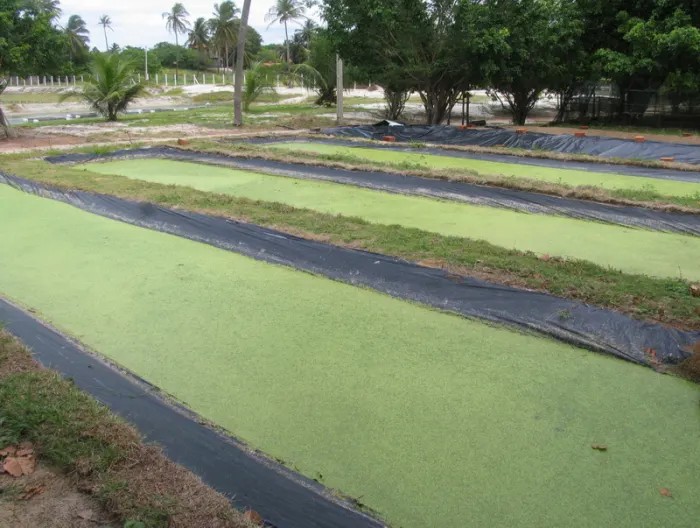
Based on data in "Lemna minor Cultivation for Treating Swine Manure and Providing Micronutrients for Animal Feed", Devlamynch et al. 2021 we incorporated the costs of a small duckweed treatment lagoon into an interactive calculator that shows the breakdown of costs in the Public inputs and outputs page. This lets you see prices for each component and remove them if you already have the required equipment. This sets our max cost per year as € 38,883, with land, excavation, and foil being the top 3 costs, totaling 70% of annual costs.
Based on our calculations for duckweed treatment lagoons we wanted to check if selling duckweed as a feed would cover the costs of cultivation with a few different assumptions. While previous calculations were done using the productivity of 10.7 dry tons/ growing season measured in Flanders in 2018, it’s been seen that improvements in fertilization, harvesting frequency, and warmer climates like those of the Brazil, Bangladesh, or even Spain could double productivity per acre. While doubling productivity halves the cost per ton of capital expenses like land and excavation, operational costs of labor, fuel, and pumps will remain the same per ton, so we calculated the operational costs as €646/ dry ton, and combined this with annualized CapEx costs to find a curve of cost per kg decreasing as productivity rises. Overall we see that the lack of a foil drops duckweed production costs at 11 tons/ha from €3.55 to €2.13, meaning the foil is currently responsible for 40% of the cost of Lemna. Developing longer lasting, easier to repair, or cheaper foils, or growing with land or water that doesn’t require a liner showed itself as an underappreciated avenue to improve cost productivity.
Oddly both the absence of a foil, or doubling the productivity from 10 to 20 tons/ha year both resulted in dropping the price per kilo by 40%. While increasing productivity 50 or 100% likely won’t improve the OpEx costs per ton too much, the next decade of cultivation research, or the scaling from a 1-10 vs a 50-200 ha farm will likely drop the cultivation costs from our calculated €646/ton to a price closer to the currently subsidized soybean price range of €350-€450/ton throughout 2024 (Index Mundi). Considering the labor of harvesting with pumps and feedbags is a major part of the operational costs, the designing of automated, conveyor belt harvesting systems for both large and small-scale ponds will be needed to compete with the massive scales of soy farms. At the €2-€4/kg price of producing a kilo of duckweed and the sale price of €0.22/kilo as a fresh feed is recouping just a small fraction of its cost, and over 90% of the value lies in its nitrogen and nutrient recapturing potential.